Wednesday, November 7, 2012


“It’s Morning Again in America.”

Obama consistently posed the same question Ronald Reagan asked in this landmark television commercial from his winning re-election campaign in 1984, “Why would we ever want to return to where we were less than four short years ago?”

Seven elections later, America has responded the same way:  we don’t!  We’ve re-elected a president who has faced a multitude of more complex issues than the economic issues Reagan based this TV commercial on.  And been confronted with a congress dedicated to the goal their House Leader, Mitch McConnell, stated at the outset, “The single most important thing we want to achieve is for President Obama to be a one-term president.”

As so many Republicans claimed following the 2010 congressional elections, “The American people have spoken!”  Indeed they have.

The Republican failure was not due to a uniquely brilliant Obama campaign, although it did resonate on several important core issues.  Nor did they fail because of a lack of spending, or a lack of focus on key swing states. The Republican failure was not because of tactical mistakes, as Newt Gingrich is asserting.  Nor do they need to reassess their strategy, as he is urging – at least that is not their primary problem.

Romney lost because the majority of Americans rejected fundamental Republican values and the very things they stand for.

Obama’s re-election is a testament to the outright rejection of a set of positions and values that run counter to everything America once stood for, rejection of a party whose platform was dragged too far to the right, and whose stance on big business, the economy, immigration, taxation, women's rights, government's role in our society, education, global warming and green energy, same-sex marriage, a trickle-down economic theory that has already failed dramatically, twice, catering to the rich, foreign policy, short-term responses to long-term issues and more - all of them rejected by the majority of Americans, and most of them long before this season's campaigning even began.

The rejection of a man who was willing to say absolutely anything – including outright lies - to appease the current political flow, as he saw it - first the Tea Party and later the center right - all of it seemingly guided by a single ego-driven compulsion to be crowned president.  And a myopic would-be underling who preached Ayn Rand without fully realizing what she stood for (or that the vast majority of his supporters would likely not know who he was talking about), and went on to contribute his own set of lies to the party platform.

The rejection of a once great grand old party whose legitimate conservative values have been corrupted by emotionally-charged extremists who haven't the first clue how to fix anything they have complained about.

A rejection dramatically underscored by the defeats Todd Akin, Linda McMahon, Scott Brown, Richard Mourdock.  Amplified by the fact that neither Romney nor Ryan carried their own home states!  Underscored by the fact that virtually every voting demographic out there went for Obama, except one - older white men.  In fact if you compare the demographic and psychographic makeup of the states Obama won vs the states Romney won, well, they differ dramatically, and say a lot about the glaring chasm between the two parties and our country.  So does the fact that Obama dominated with urban voters, Romney with rural.

This country would benefit, again, from a healthy balance with a Republican party that once upon a time was center-right, and committed to solving issues, thru compromise when necessary, and who at least represented a reasoned alternative - not the party they are today, openly committed to limiting Obama to a single term, no matter the cost.  Well, it didn’t work, so now what?

Obama has us on the right track, generally - his intentions are certainly honorable - and now his efforts have been re-endorsed by much of America, even though many of us are hoping he'll be able to do a lot more than he's done to date.  The single primary reason he hasn't been able to, and won't be able to, is if the Republican congress continues to be beholden to a Tea Party and Norquist mentality and refuses to consider reasonable solutions and compromises.  If they continue to dig their heels in, the Republicans are destined to remain the minority party for a long time to come.  Obama has demonstrated a willingness to compromise.  Are the Republicans?

Had Romney won we would have owed the rest of the world an apology, an explanation that what he represents is not America, nor do Akin, McMahon, Mourdock.  As it stands, we should still apologize for allowing them to get so damned close.

Above all, we remain a divided nation.  The senate gets a bit more Democratic, likely given their broader constituencies, the house a bit more Republican, probably a result of narrower, more isolated bases.  I agree with the description of Obama's re-election as not so much a mandate as one of renewed hope that he'll be able to take better advantage of this second chance.  

Hope, indeed, that they've all gotten the message.

Tim Arnold
Croton on Hudson, NY
7 Nov 2012
www.possible20.com
tim@possible20.com


Tuesday, August 7, 2012

Only in America

As published in
July 25, 2012
                                               
Only in America.

The massacre in the Aurora movie theater should surprise no one.  After Virginia Tech, after Columbine, after Jordan Lee Loughner’s assault on Gabby Giffords, it should surprise no one.  And that’s just the latest.  Count on it, it’s going to happen again. 

We’ve created a perfect storm for random violence.  The blame reaches far and wide, and pundits’ psycho-babble, legitimate and otherwise, is already raining down around us, again.  Societal permissiveness.  Violence in the media.  Video games.  Parental acquiescence.  The pressure to succeed.  Ultra-conservative dogma.  Promiscuity.  Movie madness. Penn State.  Digital replacement of personal relationships.  Heavy metal music.    

All of it – and none of it - true.  And one more thing:  the absurdly easy access to guns, enabled by champions of the loose interpretations of “the right to bear arms.”  And the unwillingness of, well, anybody, to confront the NRA.

All of it, uniquely American.  Who to blame?  You, me, Republicans, Tea Partiers, Democrats.  All of us.

The statistics are mind-numbing, and undeniable.  There’s nearly one gun in America for each one of its citizens.  Of the estimated 300 million firearms, owned by some 70 to 80 million adults, 100 million are handguns (“Firearms Fact Card, 2010.  National Rifle Association”).  We lead the civilized world in homicides by firearms (Nationmaster.com/ crime statistics).

The AR-15, one of the weapons the Aurora suspect carried, is a lightweight, air-cooled, gas-operated, magazine-fed semi-automatic rifle.  Automatic variants have a three-position rotating selective fire switch, allowing the operator to select between three modes:  safe, semi-automatic and either automatic or three round burst, depending on the model (Wikipedia, AR-15).  It was banned – and compatible magazines were limited to ten rounds - in 1994, but all of it rescinded 10 yrs later by a Republican-led congress under pressure from the National Rifle Association.  Today a legal AR-15 is capable of firing 800 rounds per minute, and a drum magazine with a 100 round capacity – which the Aurora suspect carried - is also legal in most states.  In fact you can buy an AR-15 online with minimum qualifications.

This is America’s weapon of mass destruction.  It is designed for one purpose, and one purpose only:  to kill a lot of people.  There is no reason for it to exist, much less be owned, outside the military.

But it does, and is, in America.

Equally unique to America are the arguments defending such madness, including:

The second Amendment guarantees the “right for individuals to bear arms.”  Except there’s an equally compelling argument that the founding fathers intended the amendment to provide for states’ rights to mount armed militias.  As ratified by the States and authenticated by Thomas Jefferson, Secretary of State:  A well regulated militia being necessary to the security of a free state, the right of the people to keep and bear arms shall not be infringed.”  This clause in the Bill of Rights is subject to as much interpretation as the Bible – and those that chose to take either one literally reveal a rigidity unfit for today’s world.

Banning assault weapons signals the beginning of a slippery slope toward an unconstitutional denial of our right to bear arms.  Did banning the “F” word on network television lead to rampant censorship, or denial of freedom of speech?  Did removing the Ten Commandments display from the Arkansas State House lead to reckless denial of religious freedoms?  And so it goes.

There’s so many guns already out there, most of them owned by bad guys, that the only way to protect ourselves is to, well, own one.  And so we do, one for every citizen in the country.  But some studies show that “in homes with guns, the homicide of a household member is almost 3 times more likely to occur than in homes without guns” (“Gun Control Facts,” by James D Agresti and Reid K. Smith.  Just Facts, Sept 13, 2010). 

We impose speed limits to make the highways safer.
We legislate fuel efficiencies to combat pollution.
We remove sugary drinks from grade schools to confront childhood obesity.
We regulate medications in an attempt to mitigate abuse.

But we do not regulated gun ownership. And the damage done by guns is more obvious, more linear and less forgivable.

Like the single raison d’etre of an AR-15, there’s one reason politicians don’t address gun control – they want to be elected more than anything else.  Their need to hold office supersedes ethics.    It’s why Mitt Romney has changed his mind on every significant issue.  Republicans are beholden to the NRA and gun rights advocates.  Tellingly, nearly twice as many Republicans own guns as Democrats (41% vs 23% - with 27% Independent.  “Gun Ownership and Use in America, Joseph Carroll, Gallup Nationwide Poll, Nov 22, 2005”).  According to the Federal Election Commission, a full 85% of all financial contributions from gun rights advocates went to Republicans in the two decades from 1990 to 2010 ("Gun Rights: Long-Term Contribution Trends." Center for Responsive Politics. Accessed September 2, 2010).

Isn’t there something in Romney’s “deep-seated” religious faith that moves him to support even some form of limited gun control?

No matter; it seems neither party is willing to confront this issue head on.

I’m with New York City Mayor Michael Bloomberg (“a leader in the search for sensible answers about guns” – NY Times Editorial page, July 21, 2012), who said, “Maybe it’s time the two people who want to be president of the United States stand up and tell us what they’re going to do about it

Louie Gohmert, Republican Representative from Texas, drew a bizarre connection between the horror in Colorado and “ongoing attacks on Judeo-Christian beliefs” (NY Times, Editorial, July 21, 2012).  He also said this, “It does make me wonder, you know, with all those people in the theater, was there nobody (else) that was carrying?  That could have stopped this guy more quickly?”  (Colorado is one of 38 “shall issue” states, meaning that if a person passes certain minimal requirements, then the state must issue them a concealed weapons “carry” permit).

But think about what Gohmert – and millions of other NRA sycophants - would have: a fully armed populace, armed and ready to defend themselves against all threats, real or imagined.  And an armed threat in a movie theater far exceeds the gray area provided for in Florida’s perverse “Stand Your Ground” law.  It’s there, it’s real, and, until he starts firing, he’s legal under America’s right to bear arms and Colorado’s right to carry concealed weapons.  But, so would other carriers.  Imagine: the “Joker,” as the Aurora wacko called himself, opens fire with his AR-15. Instantly, another carrier responds with, say, a Glock – a popular semi-automatic pistol from Austria, also legal, also available online, and capable of firing 33 rounds from a high-capacity magazine. (The “Joker’s” carrying one of these, too). He misses – but he’s got 32 rounds left, and continues firing. Then a half-dozen more legal carriers engage, firing at, who?  The Joker?  Or, the first defender – or each other? - because, after all, how would they know, there in the dark of the movie theater, who was who?

And so ensues America at its finest.  More movie goers rise to the occasion, all legally armed and carrying, pickling off rounds of semi-automatic ammo in the dark, scoring hits, misses, wreaking havoc, killing … other movie goers, their children and each other.  And in short order, there’s but a single soul left standing, having exercised his or her right to bear arms and defend his own American self.

Alas, he’s mortally wounded, too.

A metaphor for what’s to come.  This is what we’ve created.

Only in America. 

Tim Arnold


Sunday, July 1, 2012

As published in the St. Louis Post-Dispatch
June 28, 2012
Thanks to Bill McClellan for bringing back some great memories.  Both KMOX Radio, led by Bob Hyland, and D’Arcy Advertising, bred by Jimmy Orthwein, generated decades of notable accomplishments, and when I arrived at D’Arcy in 1973 out of school they both had healthy, symbiotic relationships with Anheuser-Busch.  AB owned the St. Louis Cardinals, and KMOX was their flagship station, generating millions of Redbird fans throughout the MidWest, early on with Harry Caray, Jack Buck and Joe Garagiola and later with Buck and Mike Shannon.

I grew up on Caray’s legendary broadcasts (“It might be, it could be – it is! A home run!  Ho-lee Cow!”) and graduated Missouri’s School of Journalism when Marching Mizzou still played “When You Say Bud, You’ve Said It All” at halftime, to rousing frat boy ovations.  So when I joined the Budweiser team at D’Arcy it was like getting to heaven without having to die first.  By the time I moved to New York 10 years later I was responsible for all of D’Arcy’s AB business – Budweiser, Michelob, Mich Light, Natural Light and their corporate advertising.  In between we launched “This Bud’s for You” and made advertising – and marketing – history.

Sharing the same building with KMOX just seemed right, and it was magic.  With a basement-parking place you never knew who you’d share an elevator with.  Buck, Highland, Bob Costas – who back then was announcing the St. Louis Spirits, fresh out of Syracuse University (“Yes!”).  Bob Starr, Bob Hardy, Rex Davis.  Jack Carney.  Fando’s was the bar we shared, connected to our building and accessible through a second floor entrance. 

Early on there was a direct partnership between KMOX and D’Arcy.  With D’Arcy’s Dolan Walsh at the lead, and on behalf of our mutual client, Anheuser-Busch, the agency literally put together what today remains to this day one of the largest, strongest MLB radio networks in the country.  Town by town, station by station, Dolan single-handedly brought dozens of stations into the KMOX network to carry the St. Louis Cardinal baseball games. And each subsequent spring he would revisit each station during the Cardinal’s Grapefruit League regular season warm ups to … extend the relationships - an absolute must business trip – and well deserved.  When “D” died they all gathered to pay tribute – Anheuser-Busch, KMOX and D’Arcy alums, and stood in honor as one of his grandchildren carried a silver tray down the aisle with a long-neck bottle of Budweiser, and a Pilsner glass, and set it on the alter.  Knowing Dolan, he poured it with the appropriate 1½” collar of foam and had a last, quintessential quaff of the King of Beers.

More memories come back …

One late night in Fando’s a couple of us have already grown Budweiser’s market share in a single sitting, and here’s Bob Costas regaling us with his imitations of Art Fern, the Johnny Carson character.  I ran in to Costas at LaGuardia Airport a couple of years ago and reminded him of that night, and he actually remembered it.  And admitted it.

Many a night sitting in the KMOX broadcast booth at Busch Stadium, right there with Jack Buck and Mike Shannon.  Jack was a wonderful guy, a genuine man for all seasons, someone to aspire to, and I did.  Of course I got to know Jack given our mutual work for AB, which I consider a gift to this day.  One time I tried to tell him how much he meant to me and he wouldn’t hear of it.  Simple humility.

One morning I forgot my card pass into our underground parking lot, and had to sit there and wait for somebody to pull in behind me so I could borrow theirs.  Soon enough here comes that somebody – it was Jack.  “Sure,” he says, “here.”  ‘Course, Jack didn’t come to work till about 11am…

What seemed like dozens of Steuben Glass sculptures displayed in Highland’s KMOX office.  The gravity of all of it didn’t fully register with me until I stopped in Steuben’s store – museum? on Fifth Avenue in New York City – not to shop, to gape.  (By the way, after decades, Steuben closed their store the end of last year – another sign of the times).

Mike Roarty was AB’s CMO back then, a larger than life figure who could hold his own on stage with Bob Hope – and did, at one of AB’s spectacular wholesaler conventions.  Mike was the glue back then, for all of us, and a dear friend of Buck’s.  Mike retired in 1994 and still resides there in St. Louis with his wife Lee.  Revered, then and now.

When I started at D’Arcy there were some 450 people working there, supporting not only our efforts for Anheuser-Busch, but also Red Lobster, Southwestern Bell, Ozark Airlines, Brown Shoe and many Ralston Purina accounts.  (D’Arcy also had the McDonald’s business through the early ‘50’s!). A vital, thriving advertising agency.  When the office closed in 2002 there were less than 50 employees.  They didn’t move to New York, they folded, having lost virtually all of their business.  I went back for the wake.  Terrible.  Must have been what KMOX felt like when they lost the Cardinals.  No, worse.

One thing’s for sure:  we never hid a martini behind a Budweiser at lunch.  We drank Budweisers.  At lunch.  Every day.  And the Michelob guys (guys, gender neutral – there were women on all of our beer accounts) drank Mich.  Etc.  Another truth:  it wasn’t at one of these lunches that somebody came up with “This Bud’s for You.”  It was back at the office.  And it came from a jingle lyric written by Larry Stillman, D’Arcy St. Louis’ creative director, who despite his position had little to do with our beer business.  But he’d written this lyric, and buried in it was the phrase, “For all you do, this Bud’s for you.”  It was left to another copywriter to recognize it for what it was, a young guy named Dave Allemeier, and turn it into a campaign idea.  The rest of us had the good sense to say, “yeah, damn, that’s a good idea!”  Any other version of the creation of “This Bud’s for You” is simply wrong, and likely self-serving.

Finally, it was time for me to move on, and I was able to leverage my beer experience into a fabulous job with the J. Walter Thompson agency in New York.  The afternoon that I turned in my resignation I took my ex-employee self down to Fando’s, pull up to the clean crisp taste of a Budweiser and wonder what the hell I’m in for now, when somebody passing by wants to know what I’m doing there – you know, between lunch and after work.  It was Jack Buck, coming in to work, and when I tell him what’s going on he sits down next to me, orders us both Budweisers and proceeds to tell me all about New York City, the good restaurants, the great bars, the museums. 

I’ll never forget it, or him.  Or any of the other wonderful memories from the best ten years of my advertising life.

Tim Arnold
Ad Man
Croton on Hudson, NY
10520

Monday, March 5, 2012


Back when Budweiser sold 50 million(!) barrels of beer per year, the idea that a pretend beer like Coors Light, a relative blip on the radar screen back then, would one day outsell it would have sounded even more outrageous than the idea that someday there'd be flavored beer. Or whiskey commercials on TV. But all of this came to pass, and more. In fact, the entire beer industry is turning upside down and inside out.

In the face of it, and to its credit, Anheuser-Busch is not sitting still. The past several months have seen the exit of Anheuser-Busch President David Peacock and the hiring of a new CMO who's determined to do the right thing. It's also changed ad agencies on its two primary brands, launched a new product to compete with spirits, announced plans to introduce several other flavored, cider- based and rum-based line-extensions, invested in exclusive sponsorships of the NFL and Major League Baseball telecasts, initiated some innovative social-media applications and spent more money on this year's Super Bowl than any other advertiser.

Better late than never. Much better.

Paul Chibe, the recently appointed CMO, has his hands full. He's inherited once great U.S. brands that are in severe erosion and he's determined to confront what he sees as the "dumbing down" of the entire category's advertising, as he told me last week. The kind of advertising (see also Miller Lite's "Man Up" campaign, et al) has contributed to the category's loss of volume to wine and spirits, hence Bud Light Platinum -- "a premium proposition" designed to "appeal to young-adult drinkers who've moved to hard liquor," as Chibe describes it.

Of the three A-B brands advertised on this year's Super Bowl, it's the Bud Light Platinum commercials that distinguish themselves from the others -- and not necessarily for all the right reasons. Both "Factory" and "Work," new 30-second spots from Translation, are decidedly un-beer like, by design. Chibe says they've "taken chances" with these Bud Light Platinum commercials. Indeed. "Factory" was an austere, industrial-looking, copy-driven intro spot, and lacked the kind of emotional engagement evident in what once passed for effective beer advertising.

"Unlike most other Super Bowl commercials, the quiet [of the piano] pulls you in," said Chibe. (Or it could also have signaled a good time to unload your Johnny Black with a splash.) The piano riff is sampled from Kanye West's "Runaway."

"Work" is set in an office (right?), and it's dark so I guess it's after work, populated with young . . . spirits drinkers ("who it's for") drinking BLP. Avicii -- the young Swede who hit the Top Ten in several international markets with "Levels," a popular dance track and the music bed in the spot -- is actually in the commercial, playing the DJ. If young drinkers recognize him, it could add buzz.

Bud Light Platinum presents the elusive liquor drinker with a riddle -- wrapped in a mystery, inside an enigma. More alcohol. But barely more than Budweiser, not nearly as much as craft beers and not even close to liquor. Will it compete with, say, scotch, for people who drink alcohol for the buzz (c'mon, admit it)? Duh. And fewer calories. But barely fewer than Budweiser (137 vs. 145) and more than any other light beer, including Bud Light's 110. Is it still a light beer? You make the call.

Will BLP energize the franchise? Yes, at least short term. Will it cannibalize Bud Light? You bet. Should it have been Budweiser Platinum? Perhaps. Is it an oxymoron? We'll see.
For brand Bud Light, the good news "there's no more morons" says Chibe. And he's right. "The beer drinker is not the butt of the joke." And he's right. There wasn't a single guy in his underwear, no over-played dipshits in McGarryBowen's "Weego," the agency's first for Bud Light since it won the business. Given the brand's recent advertising history this is indeed a significant accomplishment. And as Chibe described it, a "smarter application" of humor, a first step in the evolution of the brand's advertising. Same tag lines, so far. Same VO announcer. A new/old humorous situation, this one with cooler people and the cutest dog in the game (with an endearing tie-in to "Help Rescue Dogs"). All signs that the brand may be growing up. So we wait, in hopes that Bud Light's more- clever version of humor, as Chibe describes it, will continue to improve target engagements and differentiate it from every other beer's version of humor.

The second Bud Light spot, from Cannonball, enlists the pop/rap duo LMFAO (well known internet slang for "laughing my fucking ass off'), whose manager mistakenly books them at "Dale's Halftime Sports Lounge," not, you know, the real halftime. Joke! Well, not really. But they squeeze in "Here We Go" in a nod to the campaign, and use the spot to introduce the real halftime -- which LMFAO really appeared in.

And then there's Budweiser. Anomaly's work continues to reposition Budweiser as the brand leader it once was. The brand's Super Bowl spots ("Return of the King" and "Eternal Optimism," both sixty seconds) were the latest expressions of this once-great brand reconnecting with its heritage, acknowledging that there's more to the beer market than sophomoric frat boys under the age of 24. Embracing optimism in challenging times -- the core strategy of "Grab Some Buds" -- exemplifies a stance a brand leader takes. And to reinforce the position, the second spot ends with "Great Times Are Always Coming." These latest examples, along with a special commercial they created for Canada -- a spot that's gone viral and will generate millions of hits before it's done -- are wonderful storytelling and emotionally engaging. And they're working. Beyond "likebility" and "brand consideration" upswings, Budweiser sales have improved from 10% and 7% declines the past two years, to last year's 4.6% decline -- notable in an industry that's undergoing significant shifts in preferences.

In the break following Bud's "Return of the King," General Electric featured a Budweiser brewery in its "Power and Beer" commercial from BBDO -- perhaps another sign that the King of Beers is indeed returning.

Also from Anomaly, and sitting under the radar, is an innovative response to integrating "product quality" into the mix. An online program -- soon to be an app -- allows you to enter the born-on- date from the very can or bottle of Budweiser you're drinking and get a multimedia story of where it came from, when it was brewed, who brewed it and more. Cool.
Anheuser-Busch InBev has a clear and critical global priority: rejuvenate the Budweiser and Bud Light franchises in the U.S. The steps it's taken in the months leading up to the Super Bowl seem to fully embrace these goals. So does the work it's aired during the game -- the good, the not so bad and the . . . wait and see.

I'm, how do they say it? Cautiously optimistic.

ABOUT THE AUTHOR Tim Arnold, a 35-year advertising-industry veteran who ran the Budweiser business for 10 years at D'Arcy, St. Louis, now runs his own consultancy, Possible20 (possible20.com/tim@possible20.com).

Monday, November 7, 2011

Bud Light Needs to Grow Up

As published in AdAge Oct 24, 2011

It’s time for Bud Light to grow up.  Which must be painfully obvious to Anheuser-Busch InBev and their new CMO, Paul Chibe, because they’ve asked a half dozen agencies to tell them how to fix a brand that for years has prided itself on “sophomoric humor,” an approach that finally, predictably, led to Bud Light’s first sales decline in 27 years, in 2009, a decline that continues to this day.

What took ‘em so long? would be a fair question.  Alas, better late than never.  Maybe.

With parent brand Budweiser’s eroding market share – from 25% to less than 9% today – another marketing travesty marked by a series of line extension and advertising missteps – Bud Light’s 2.5% decline in ’09 sparked some clumsy attempts to reconnect with their LDA – 24 yr old user base.  Trouble was, both their “Drinkability” and “Here We Go” campaigns were not only strategically flawed, but still mired in “sophomoric humor,” a kind of humor that ultimately held their target beer drinkers up to ridicule – not a great idea.  It’s like “dumb ass” was actually part of the brand’s defined personality. 

Thing is, there are some fundamental truths about beer advertising that I always thought were obvious, but apparently not, because Bud Light has violated all of them in recent years.  And if they’re to have a chance of re-establishing any relevance to today’s beer drinkers they’d be well advised to consider the following “New (Old) Rules,” I’ll call them, with apologies to Bill Maher …

New (Old) Rule:  to co-opt a political rejoinder, “It’s the strategy, stupid.”

Until last year’s Super Bowl, Bud Light’s advertising had insisted that it represented “Drinkability” – a word lifted right off of Budweiser’s label, proudly proclaiming for decades that Bud has “… a taste, a smoothness and a drinkability you will find in no other beer at any price.”  Thing is, it was believable; it made total sense for Budweiser.  It made no sense for Bud Light.  So they changed it to “… just the right taste,” which is what every beer drinker in the entire world already thinks about his beer.


Once they figured out that “Drinkability” was at best a product “reason why,” and at worst irrelevant to the light beer category, Bud Light’s next and current campaign, “Here We Go,” was “intended to convey that Bud Light is a ‘catalyst for good times,’” according to Keith Levy, A-B’s then CMO (NY Times, Jan 26, 2010).  “When Bud Light shows up, the party is going to begin.”  Not exactly a strategic point of difference.  And somehow I don’t think partying carries the same gravitas as, say, hard work, or camaraderie, or even chilling on a beach – all of which represent relevant strategic territory beer brands have actually owned, successfully. 

They might as well have called that one “Here We Go, Again.”  Because first and foremost a beer strategy has to define a relevant, emotional connection to beer drinkers.  And it’s got to be more than … fun. Then something akin to a desired – and relevant - brand personality needs to describe the connective tissue.  And then justify it all with a viable product attribute or two. That’s the strategic equation.  In that order.  In other words …

New (Old) Rule:  Beer drinkers buy the image – not the ingredients.  Not even the taste. 

Mass market beer drinkers rationalize their choices – in focus groups - based on the ingredients, and its “quality,” or its brewing process, which they’ll even interpret as “taste,” but nobody makes real beer choices based on rational reasons. Maybe the craft beer drinkers do (nah, maybe not), but not real, regular human beer drinkers. 

So, above all, you have to connect with them emotionally.  Make a relevant, emotional connection, in the context of beer drinking.  The essence of beer drinking is guys hanging out in a bar, sucking down suds, thinking they’ve still got it, and can still get some if they wanted to, and knowing they’re in good company.

The essence.  The reality is most beer is consumed away from bars, a lot of it at home, with wives.  But home is boring in beer advertising.  So you try to capture some kind of emotional essence.

Everybody knows you can justify anything through focus groups.  You hear what you want to hear – especially if you’re looking for respondents to feed back an ingredients message.  Sure, they’ll tell you, they heard it, and yeah, it’s meaningful.  But they’re lying. They don’t care about product attributes; they’re only using them to rationalize an emotional decision. I mean, how many guys are actually going to admit they drink Budweiser because it reinforces their wannabe image of themselves, or their need for their friends to really really like them?

They must not care about taste, either.  A-B’s president, Dave Peacock, was quoted not too long ago saying, “(Budweiser) wins blind taste tests again and again.  It’s the perfect liquid.” (St. Louis Post-Dispatch, Aug 20, 2010, “Can Budweiser, the King of Beers, reign again?”) Meanwhile the brand was tanking.  Which is exactly my point.  Taste is not the priority – as long as it tastes like beer and it has alcohol in it (“It’s all good beer,” A-B’s brew master used to say.  He knew).  If it was, Bud wouldn’t have dropped from a high of 26% market share in 1988 to 8.7% today (Beer Marketer’s Insights data).


New (Old) Rule:  Beer isn’t funny, or goofy.  Or sophomoric. 

Beer drinking ain’t funny, either.  It’s … reparative, irreverent, satisfying, thirst quenching, rewarding, all about bonding and camaraderie.  And hooking up.  It’s … cool.  A good time, too, for sure; fun, but … not funny, unless maybe you’re drunk. This was another major flaw in Bud Light’s “Drinkability” campaign and continues to be with “Here We Go:” they seemed to assume it was Bud Light’s “sophomoric humor” that had been lost, so they tried to recover it with “Here We Go.”  And guess what?  They did.  

There’s a fine line between being almost funny, or worse – goofy – and irreverent; between humoring yourself and connecting with the target.  If I don’t like the guys in your commercials, I ain’t drinking your beer.  The great DDB campaigns for Bud Light – Spuds McKenzie; “Yes, I am;” “I Love You, Man,” were not sophomoric and they were beyond funny:  they were irreverent, unexpected, wise guy attitudes that defied all sense of the expected.  They invited you to laugh with them, not at them, or at each other.  All of them expressing emotions and attitudes that beer drinkers could relate to, and did. 

Yeah, grab-ass beer drinkers drink Bud Light, too, and Budweiser. But only because they aspire to be something else, like genuine Bud drinkers.  Market to the real Bud/Bud Light drinkers - the mopes will come along, too.

With “Grab Some Buds,” from Anomaly, NY, Budweiser has climbed out of that same rut with relevant, engaging advertising that re-assumes the position of a one-time brand leader, driven by a strategy that says that “we’re all in this together, good times are coming, so grab some Bud’s, and some buddies, and let’s go for it!”  It’s giving beer drinkers credit for, you know, having their acts together, or something.   All of it reflected in the kinds of genuine beer-drinking occasions and beer drinkers we’d all like to be part of.  Reports are that it’s working. It’s gaining (re)consideration and likeability in several major markets, and if they stick with it they stand a damned good chance of regaining some lost ground.  At least they’ve re-assumed the position of a genuine brand leader.

And it took some growing up of their own.  Budweiser’s previous campaign, “It’s What We Do,” was both strategically and executionally flawed.  Bud’s problem wasn’t what they did; they’ve been brewing great beer since 1876 (and continuing to “win blind taste tests again and again,” according to Peacock). Nope - it was the brand’s disconnect with beer drinkers that was the problem.  Only some kind of dipshit would take the kind of “kidding” in dumb silence that you see in one of the “It’s What We Do” spots.   If some guy says to me, “Hey, I like your ‘stash, but where’d you dock your steamboat,” my answer is, “Yeah, and your girlfriend likes it, too.  In fact she’s outside in my steamboat, waiting for me to give her a ride.”

  
And what’s with the dorks in Bud Light’s “Clothing Drive?”  Is that supposed to be us beer guys up there on the screen, wandering around the office in our underwear with our flabby pink guts out in front of us?  If it is me, I’m not admitting it.  But it must reflect the essence of how Bud Light has seen their franchise, because they were running an extra-long version of it on their website.  


New (Old) Rule:  It’s about the beer drinker first.  Then the beer.

Connect with the beer drinker on an emotional level – his, not yours; get that right, then offer him your beer.  Relate to him, reach him, give him something to identify with.  To aspire to, even. The badge to wear.  Something … meaningful.  Something positive.

Beer drinkers aren’t morons.  Or dipshits.  They can spot bullshit a mile away.  You wouldn’t know that from Bud Light’s “sophomoric humor,” or even Budweiser’s “It’s What We Do” campaign.

Actually, in some kind of perverse way, Budweiser’s earlier advertising got the equation right:  they did put the beer drinker first.  Trouble is, they put him down.  Maybe I’m too sensitive, or too bald, but being reminded that we white boy bro’d our way thru some goofy man-greetings over the years just ain’t gonna win me over.  In life we should be able to laugh at ourselves.  It’s trickier in advertising.

New (Old) Rule:  All beer drinkers are not alike. 

Budweiser discovered this way back with the launch of “This Bud’s For You” (full disclosure:  I was instrumental in that campaign with D’Arcy, St. Louis, as a young account guy who ended up running that business for nearly ten years).  As successful as that campaign was, it was even more successful with its ground-breaking market segmentation: special, reinforcing marketing and advertising specifically targeted to young adults (as we called them back then), Blacks, Hispanics and even women.  Efforts that regained #1 shares in each of these segments with provocative, relevant messaging.

We went radical with young adults, creating special, targeted commercials for Saturday Night Live.  What we did not do was try to be young and cool and stupid to everybody.  We isolated that stuff for that segment.  But we defined it as “irreverent,” not “sophomoric.”  Big difference.

If Bud Light has become “my father’s beer” – the kiss of death in beer – then you’ve got to speak to their offspring, in their language.  In their environment.  To them.  But first of all, there’s no damned reason to walk away from us fathers.  We drink a lot of beer, too, plus we’ve got more money.  It may take something more radical to reach the LDA – 24 yr old beer drinkers, to shed the old guy image.  But don’t compromise it by trying to be that way with everybody.

What is the over-arching Bud Light platform that speaks to their heaviest beer drinkers?  And how can it be reinforced with segments critical to their success: LDA-24 yr olds, Hispanics and Blacks?

New (Old) Rule:  Assume the position of a brand leader.  Leaders lead, they don’t follow. Leaders set the standard, they don’t respond to lesser brands.  And they certainly don’t stoop to their level.  Leaders are proactive, not reactive.  Leaders innovate – not imitate.

Bud Light endures as the world’s largest selling beer – leaving parent brand Budweiser in its wake in 2001 - but Coors Light continues to gain on them and may even pass Bud sometime soon to become the world’s second largest selling beer.  Bud Light (like Budweiser) has tried to staunch the bleeding with me too line extensions (Bud Light Lime came on the heels of Miller’s earlier lime-flavored entry, Miller Chill; Bud Light Golden Wheat followed Miller’s test of and subsequent decision not to introduce a Miller Lite-branded wheat beer under its Brewer’s Collection.  And now there’s talk of a new Bud Light Platinum, with a higher alcohol content.

Thing is, it’s the primary Bud Light brand that’s the problem, and line extensions are only going to make it worse. It’s time they acted like the dominant light beer category leader.  Like the world’s largest selling beer.  It’s time for Bud Light to assume the position and reinvigorate a franchise that continues to erode at the edges.  It’s time for the brand to grow up.

Tim Arnold
Advertising Age
Oct 24, 2011


Saturday, August 20, 2011

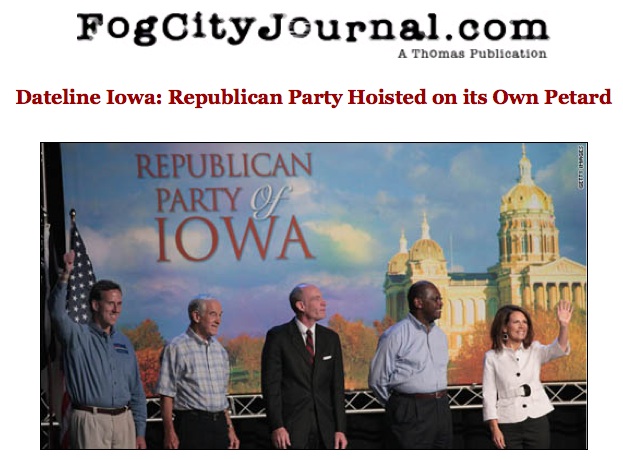
Dateline Iowa/Republican Party Update: Hoisted by its Own Petard.


Let me see if I've got this ... right:


Michelle Bachmann, who's beholden to evangelical Christians and whose beliefs stem from the dogma of Francis Schaeffer, who argued in his film series (“How Should We Live Then?”) that "Christians, and Christians alone are Biblically mandated to occupy all secular institutions until Christ returns" (and claims the US government controls all us citizens thru psychotropic drugs), whose husband runs a clinic based on "curing homosexuality thru prayer," (because gays, as she says, are "part of Satan") and whose position on our nation's economy would doom the US to bankruptcy (even S&P had to correct her assessment of their credit downgrading), all while she continues to benefit from government farm subsidies, triumphs in the Iowa straw poll over ...


Ron Paul – barely:  Paul landed less than a single percentage point behind Bachmann (although your wouldn’t know it from the conservative media’s instant anointment of Bachmann, Romney and Perry as the party’s “Top Tier Candidates”).  A perhaps surprising showing in this conservative state since many of his libertarian positions are, well, provocative: legalize marijuana; abolish income tax; allow Iran to have nukes (“everybody else does…”); pull the US out of the United Nations and NATO – and the Middle East; allow states to secede from the union; eliminate the Federal Reserve; eliminate legal tender laws and sales tax on gold and silver – heck, let the free market determine monetary standards.  Dr No has voted against virtually every initiative for government spending and new taxes in his 14 years as a Texas Congressman – more no’s than any other office holder.  All of which impressed Iowans enough to rank him the second most-desirable Republican candidate.  The American People – in Iowa – have spoken!  But who’s listening?


Willard Mitt Romney – who “didn’t participate” in the Ames Straw Poll, lest he have to explain his successful universal health care program for his home state (note: you can run – but you can’t hide), who showed up anyway and said, "hey, corporations are people, too, my friend," which is no surprise coming from him, given the millions major corporations have donated to his campaign, knowing he'll continue to support non-taxation of same. This includes Bain Capital, his former private equity firm, who has anonymously donated $1million to his campaign.  His resume now features his 20 yrs in the corporate world as more relevant than his minimal 4 yrs in political office.


Tim Pawlenty – TPaw - who once had the courage to stand up to W and Karl Rove over their attack of Iraq, and who has offered himself as a potential leader of the free world, picks up his toys and stomps out of the very first competition because he finishes a dismal 3rd.  And, like the rest of his fellow running mates, cowers to the Tea Baggers - whose financial platform will continue to cripple this nation, given Washington's refusal to stand up to these Nazi's.


Newt Gingrich – who, during his first week as a presidential candidate labeled fellow Republican Paul Ryan’s budget proposal “right-wing social engineering,” causing most of his fund raisers to flee, followed by all of his staff leadership soon after, and whose third wife obligated him to a $hundred thousand debt at Tiffany's - and who’s also willing to eviscerate Medicare, Medicaid and Social Security and continue W's tax cuts on the wealthy.  All of which illustrates his arrogant hypocrisy.


Rick Santorum - who's slathering for extreme right-wing voter support exceeds even his competitors’, and leads him to equate gay marriage with incest, akin to "a father marrying his daughter."  Which not only is irrelevant but, as further evidenced by every single last one of his Republican running mates’ platforms and in addition to its pathological ignorance, has absolutely nothing to do with the genuine problems this nation is facing today.
Herman Cain – who cares?


And then there's Rick Perry, who proudly proclaims his father-in-law performed his vasectomy as a campaign point, who has totally confused separation of church and state with his keynote at the Texas Christian Prayer Rally – having already extended official state support to the Islamic community through his personal and official relationship with “His Highness” Prince Shah Karim A-Husayni, the Aga Khan IV, and the spiritual leader of the Shiite sect of Nizari Ismaili Muslims, whose 18 million strong believe he is a direct decendant of Muhammad.  Perry, who’s been described as W2, who allowed as how Texas should maybe secede from the United States of America, whose coffers are over stuffed with corporate millions of dollars, who's spent hundreds of thousands of dollars of tax payer's money on vacations and foreign "trade missions," whose state ranks at the very bottom in public education and whose claims about Texas’ financial strengths are a myth, who argues that the US has no constitutional right to mandate income tax and who's hypocritical madness could actually boost him beyond Bachmann as the Republican Tea Party candidate for US president.  Yeah, Perry’s got balls.  Which only proves it takes a hell of a lot more than that to qualify for President.


Oh, wait.  Sarah Palin showed up in Iowa, too.  When asked if the president was to blame for the nation's credit downgrading, she said "... yes.  Because from the top, leadership starts from the top, the leadership of our country."


Spoken like the true genius she is, another passenger on the Ship of Fools that is the Republican Tea Bagger party.


The Republican Party continues to demonstrate its utter lack of ideas, its sense of reality and its ability to accomplish anything constructive.  Drowning in its fear of the Tea Party, it is polluted with rabid political bias, consumed by a Nazi-like rage and driven by its single-minded myopia to get rid of Obama at any and all costs - all of which is tantamount to hoisting itself by its own petard, doomed to failure and guaranteed to extend the Democrats' hold on the White House.

Have a nice day.


Tim Arnold


15 August 2011
Possible20
www.possible20.com
www.possible20.blogspot.com
917.748.6058